Most of Europe has a temperate climate characterised by clearly defined seasons, warm summers, and cold winters. However, temperature fluctuations are accompanied by another important factor that we often only notice when it starts affecting our well-being – humidity.
Why is indoor humidity important?
When the air is too dry, we experience dry skin and mucous membranes, poorer sleep quality, increased susceptibility to illness, more difficult breathing, and a higher risk of airborne infections. Excess humidity, on the other hand, makes indoor spaces feel stuffy, increases fatigue, and creates favourable conditions for mould growth in both building structures and household appliances.
Indoor humidity levels vary significantly throughout the year. During winter, outdoor air is cold and naturally dry. When we heat our homes, the indoor air warms up and the relative humidity decreases even further. In summer, outdoor air is typically warm and humid, meaning that excess moisture entering the building can increase discomfort and make cooling more difficult. If a building is airtight and ventilation or humidity control is insufficient, moisture imbalance can occur.
According to researchers, the most comfortable relative humidity level for people is between 40% and 60%. This humidity range helps slow the spread of microorganisms through airborne droplets and supports a healthy and comfortable indoor environment. Therefore, maintaining a balanced humidity level at home is not merely a matter of comfort – it is directly linked to our health.
How do enthalpy ventilation units help maintain humidity balance?
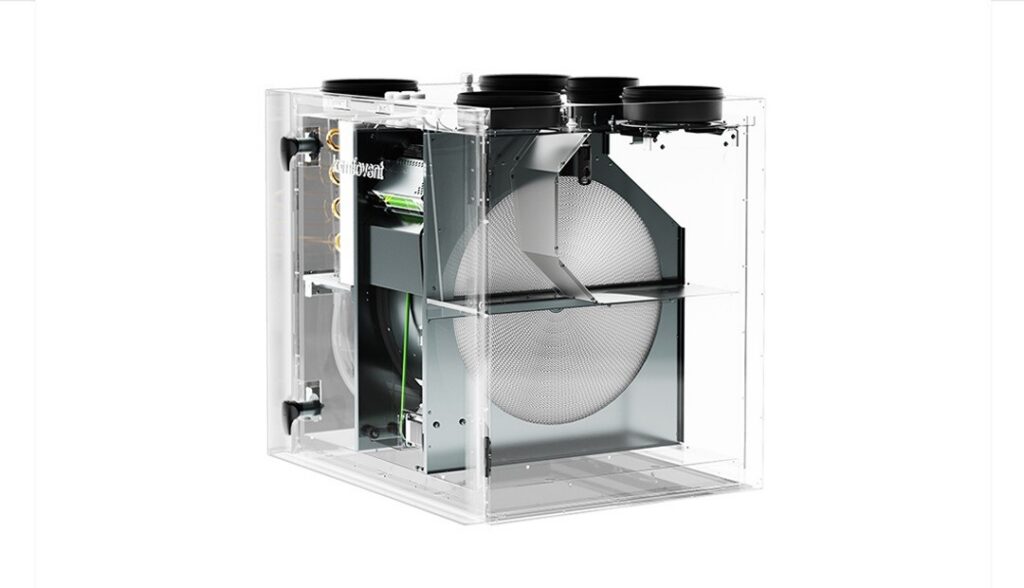
A standard heat recovery ventilation unit typically achieves approximately 90% temperature efficiency. However, condensing plate heat exchangers do not recover moisture, which is why homes using such systems often experience dry indoor air during winter. A rotary heat exchanger condenses part of the moisture from the extracted indoor air and transfers it to the incoming fresh air. It also helps remove excess indoor humidity. Nevertheless, the performance of conventional heat exchangers may not always be sufficient. The cold European winter of 2025–2026 demonstrated how quickly indoor air can become dry when outdoor temperatures drop to −20°C or below and homes are continuously heated. Once relative humidity falls below 30%, the negative effects and discomfort described above begin to appear.
Komfovent DOMEKT residential ventilation units are available with both counterflow plate heat exchangers and rotary heat exchangers. As standard, these units are equipped with condensing heat exchangers, while enthalpy versions are available as an option. Enthalpy counterflow plate heat exchangers can recover up to 87% of heat and provide a moisture transfer efficiency of up to 73%. Sorption-enthalpy rotary heat exchangers represent the most efficient and advanced solution for maintaining indoor humidity balance, with moisture recovery efficiency reaching up to 90%, compared to up to 60% for a typical condensing heat exchanger. With a sorption-enthalpy ventilation unit, there is no need for a humidifier to combat dry indoor air during winter. During summer, when outdoor air is humid, cooling costs can be reduced by up to 1.5 times.
Necessity or Luxury?
Maintaining humidity balance with a sorption-enthalpy rotary heat exchanger is a highly effective passive method of indoor climate control. It also eliminates the need to invest in additional humidification equipment. This is an economical, long-term solution that operates reliably even when outdoor temperatures fall to −30°C. Compared to units equipped with counterflow plate heat exchangers, it does not require a pre-heater, humidifier, or condensate drainage system.
It is important to remember that a sorption-enthalpy heat exchanger not only retains moisture but can also partially remove it when indoor humidity levels become too high during summer or at other times of the year. As a result, these ventilation units provide a versatile solution for creating a healthier indoor environment, improving everyday comfort, and reducing energy consumption without additional systems or extra investment.
If you would like advice on which Komfovent ventilation solution is best suited to your project, contact us – we will be happy to help you choose the right unit.